Share on LinkedIn
7 October, 2026
Posted: 14 September, 2026
Public Spaces: Culture and Integration in Europe (2019 – 2022)
PUblic REnaissance (PURE): Urban Cultures of Public Space between Early Modern Europe and the Present 2019-2022)
The Humanities in the European Research Area (HERA) is a collaborative partnership of 26 national research funding agencies from 25 European countries. In summer 2026, two AHRC interns, Princess Kunadu and Sammy Morgan, explored the long-term impact of UK involvement in HERA-funded research by contacting project leads to gather stories about what their research has achieved since completion. The team developed six responses into stories highlighting the lasting value of European collaboration.
Learn more about the process of collecting the stories
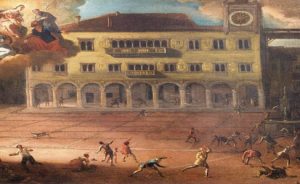
Credit: Public Renaissance: Urban Cultures of Public Space between Early Modern Europe and the Present (Pure) – FBK ISIG, painted by Antonio Lazzarini
Through PUblic REnaissance: Urban Cultures of Public Space between Early Modern Europe and the Present a team of researchers in Italy, Germany, the Netherlands, Spain and the UK examined how modern European cities have been shaped by the habits of ‘city-dwellers’ between 1450 and 1700. The project, led by Professor Fabrizio Nevola at the University of Exeter, used comparative research across Exeter, Deventer, Hamburg, Valencia and Trento to develop the concept of the ‘Public Renaissance’, which aims to shift dominant historical narratives away from an elite and instead demonstrate the importance of ordinary people in shaping the public spaces we continue to enjoy today.
Significantly, this research led to the development of five urban history apps that have proven both commercially successful and incredibly effective in enhancing public understanding of urban history. Now collectively referred to as HistoryCity, the collection of apps combines academic research with digital GPS technology enabling people to embark on immersive ‘time travel’ trails and experience their local areas through the lens of an ordinary 16th century citizen.
The approach has proved highly successful as a form of digital public history leading to partnerships and contracts to develop and adapt the model in various other locations. HistoryCity currently offers 25 free trails in 11 cities and towns across Europe – each built on new partnerships with organisations generated separately to the initial funding grant. In 2025, the National Trust launched its HistoryScapes in collaboration with HistoryCity to provide immersive, virtual historical experiences for visitors. Similar examples across Europe demonstrate HistoryCity’s success in establishing commercial partnerships and contracts.
The groundbreaking nature of HistoryCity’s ability to combine deep cultural research with cutting edge technology is reflected by the app being awarded both the Heritage in Motion international prize for virtual and augmented reality and the Best in Heritage award. These prominent European initiatives celebrate excellence and innovation in museums, cultural heritage, and digital storytelling.
Through its European collaboration, historical scholarship and innovative digital public engagement, PURE has enabled contemporary individuals to appreciate the histories of place. PURE’s legacy continues through the expansion of the HistoryCity model into new cities and heritage settings.
Professor Fabrizio Nevola | Exeter University | [email protected]
Written by Sammy Morgan