Share on LinkedIn
7 October, 2026
Posted: 14 September, 2026
Uses of the Past (2016 – 2019)
CitiGen: Identity, Citizenship and Nationhood in the Post-Genome Era
The Humanities in the European Research Area (HERA) is a collaborative partnership of 26 national research funding agencies from 25 European countries. In summer 2026, two AHRC interns, Princess Kunadu and Sammy Morgan, explored the long-term impact of UK involvement in HERA-funded research by contacting project leads to gather stories about what their research has achieved since completion. The team developed six responses into stories highlighting the lasting value of European collaboration.
Learn more about the process of collecting the stories
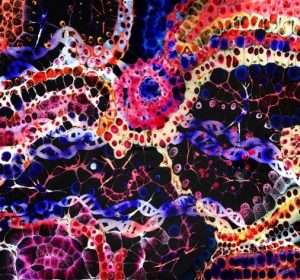
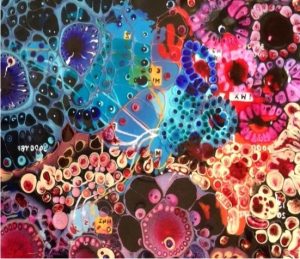
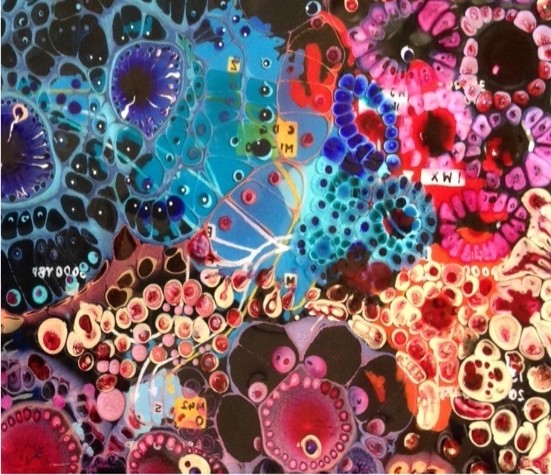
Credit: Micro Chroma series, Kate Grant. Artwork commissioned by the CitiGen project
As public interest in DNA testing continues to grow, questions about ancestry, identity, citizenship, and belonging have moved from academic debate into everyday life. However, genetic information is often oversimplified, creating the risk of complex histories being deliberately misinterpreted to support exclusionary or racist narratives.
Led by Dr Hannes Schroeder at the University of Copenhagen, CitiGen: Identity, Citizenship and Nationhood in the Post-Genome Era brought together geneticists, historians, archaeologists, and anthropologists from across Denmark, Iceland, Ireland, and the UK (Professor Matthew Collins, University of York) to address this challenge. By combining scientific evidence with historical and cultural context, the project developed new and innovative ways to bridge the gap between genetics and the humanities.
CitiGen demonstrated that genetics cannot “prove” cultural identity and that genetic data must be understood alongside historical, linguistic, and archaeological evidence. This “biocultural perspective” challenges simplistic narratives about race and provides a more nuanced understanding of diversity and social change.
Beyond academia, CitiGen worked directly with museums, educators, and ancestry-testing companies such as AncestryDNA and LivingDNA to improve public understanding of human diversity and migration. Researchers helped strengthen the scientific process of finding one’s ancestry whilst also developing more accurate and inclusive ways to describe ancestral populations. The project created educational resources for primary and secondary schools, helping young people across the country engage critically with questions of ancestry and identity.
To make research accessible to wider audiences, CitiGen developed the Ancient Genome Atlas, a free online platform that continues to allow users to explore more than 5,000 ancient human genomes across time and space. The resource has supported researchers and educators as well as members of the public seeking to understand genetic evidence within its broader historical context.
By promoting evidence-based and inclusive narratives, CitiGen has helped counter the misuse of genetic science in racist, xenophobic, or exclusionary practices. Its influence continues through ongoing partnerships with DNA companies, research collaborations, museum engagement, and the introduction of the international Archaeomics PhD Summer School in Copenhagen, which continues to train the next generation of researchers, hosting 20 students every year from all over ether world.
Professor Matthew Collins | University of York | [email protected]
Written by Princess Kundu
Hannes Schroeder, University of Copenhagen ([email protected])
Matthew Collins, University of York ([email protected])
Dan Bradley, Trinity College Dublin ([email protected])
Gisli Palsson, University of Iceland ([email protected])
Sarah Abel, National Autonomous University of Mexico ([email protected])