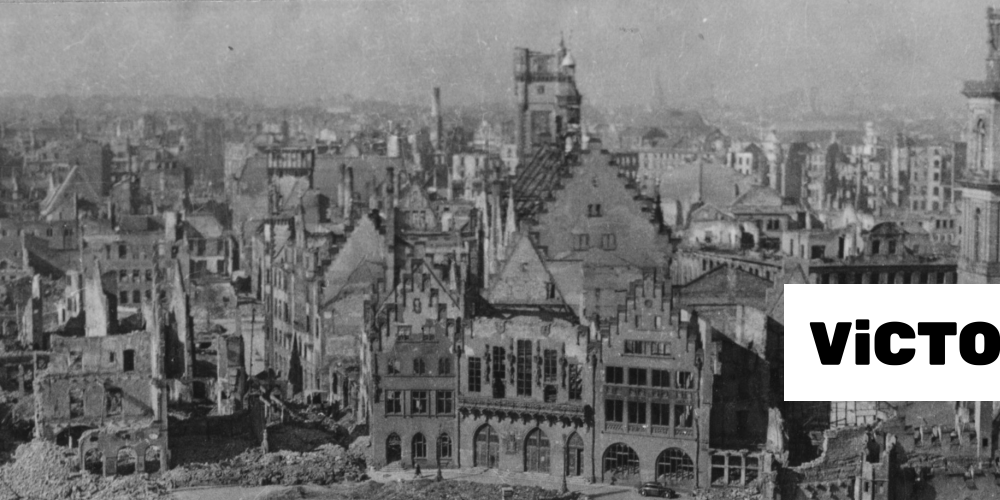
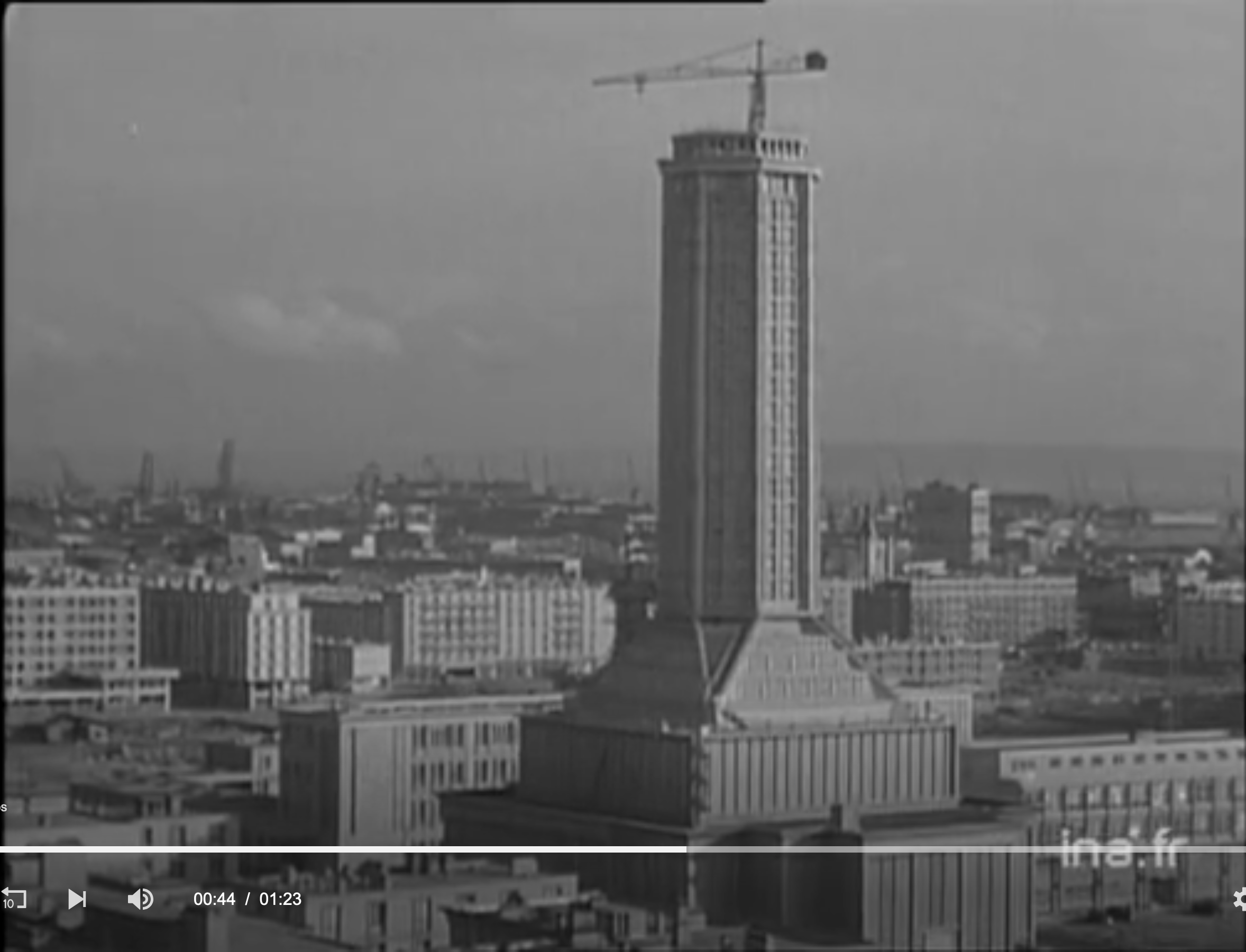
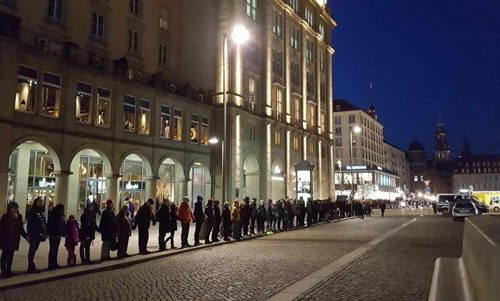
ViCTOR-E explores non-fiction films about the rebuilding of local, national and transnational communities across Europe in the period from 1945-1956 and asks how the audiovisual representations of public spaces – and particularly the documentation of war damage and of reconstruction efforts – have shaped the politics, policies and polities of post-WW II Europe.
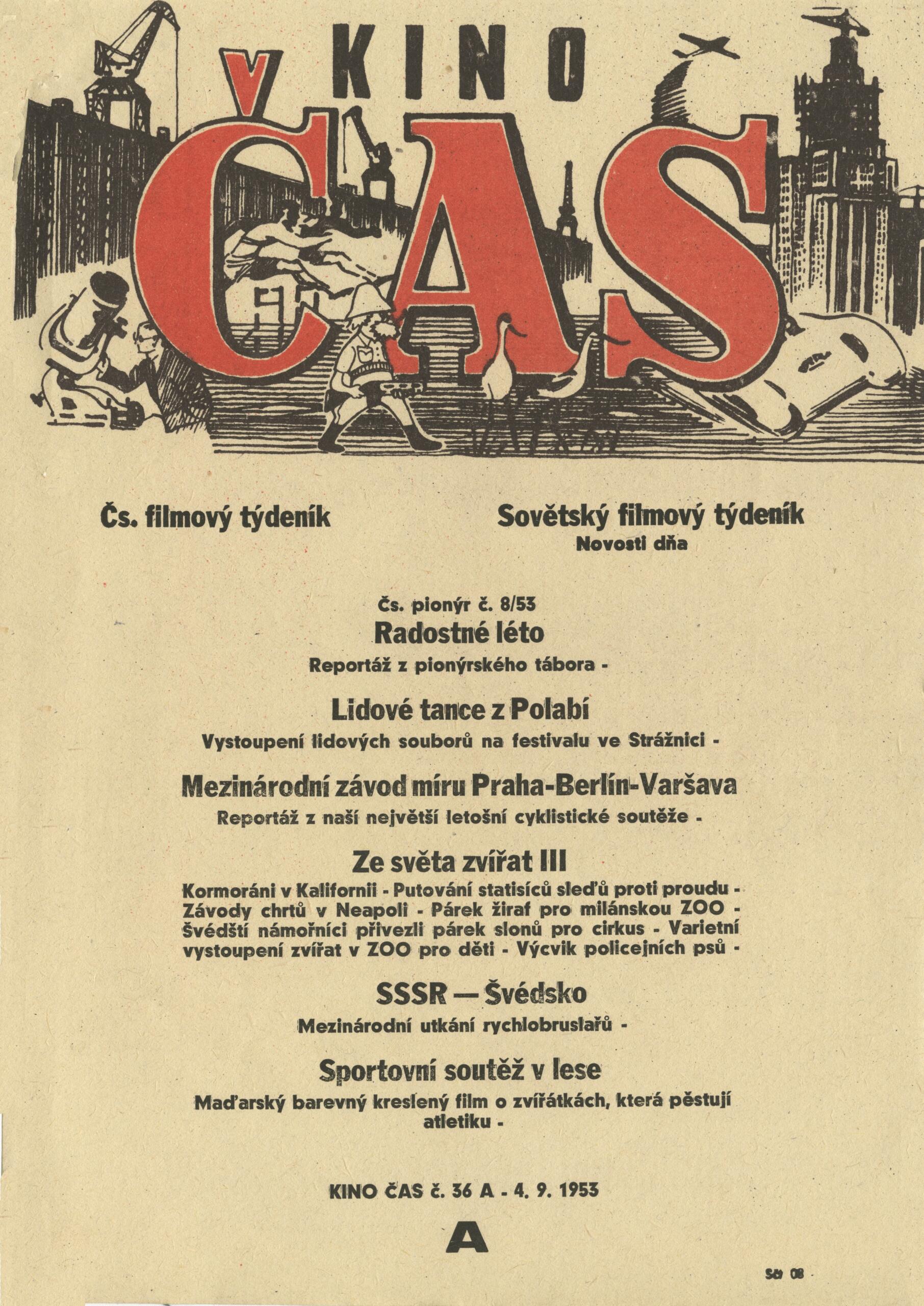
Program leaflet for the short films cinema “Čas” (1953), with a motive of reconstruction in the illustration at the top of the page. Source: NFA.
Describe your project development to date
General Research, archival and oral history research
Framing post-war culture as a culture of trauma and transition and looking at public space as a privileged site for the discursive construction of regional, national and supra-national communities, ViCTOR-E studies the political iconography of public spaces in non-fiction film from the cessation of hostilities (1944-45) until the Thaw (1956) in a transnational, comparative perspective and with regard to a wider historical visual culture, including photographs, maps or popular culture.
To do so we explored numerous (film) archives where we gathered and analysed filmic and non-film materials. Furthermore, we selected films that have been digitized and made accessible to the public in the framework of the project
In addition to that, over 40 oral history interviews with eyewitnesses from our research period have been conducted in the Czech Republic, Italy, France and Germany during the last two years.
Our research efforts not only resulted in numerous academic publication but in the development of the Online Exhibition “Frames of Reconstruction” designed for a wider audience.
Conferences, Publications
The Czech team of the CRP has organized the mid-term (online) conference “Migrating Archives of Reality. Programming, Curating, and Appropriation of Non-fiction Film” [image 10_]
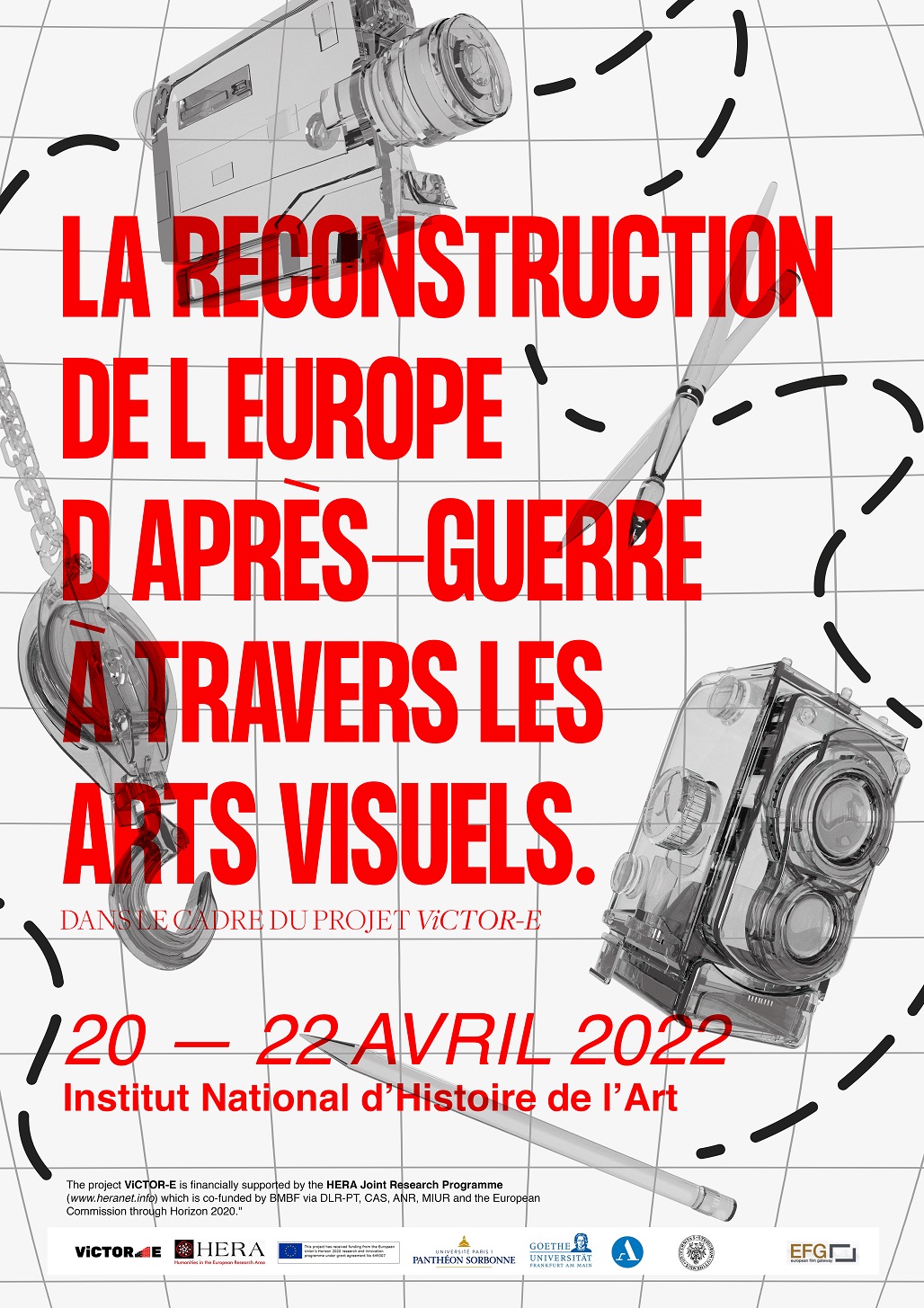
The final conference” The Reconstruction of Post-World-War II Europe through Visual Arts ” organised by the French unit taken place at the INHA (Institut National de l’Histoire de l’Art) in Paris in April 2022, [image 09_]
Link to CFP: https://www.victor-e.eu/media/archive/CfP_Paris_ENG_FR.pdf
The CRP has prepared and delivered several joint papers and panels [see list] and is currently preparing the final volume Non-fiction Cinema in Post-war Europe. Visual Culture and Reconstruction of Public Space, a collection of essays from members of the CRP as well as other experts that will be published by Amsterdam UP both in print and in Gold Open Access at the beginning of 2023.
Apart from that, a publication of the proceedings of our mid-term conference “Migrating Archives of Reality” has already been published as a special issue of Iluminace. The Journal of Film Theory, “History and Aesthetics, Migrating Archives of Reality. Programming, Curating, and Appropriation of Non-Fiction Film”, 1/2022, has already been published. OA at https://www.iluminace.cz/index.php/en/
Virtual exhibition and film collections, film screenings
The units organised several film screenings on various topics in the framework of the project in museums and cinemas and workshops with partners from the cultural, archival and pedagogical sector. Most recently a retrospective at the 25th Ji.hlava International Documentary Film Festival about the Karlovy Vary film festival: „Karlovy Vary as the Documentary Rupture of the Iron Curtain“
Workshops and seminars with history teachers and high school students, i.e. “Non-fiction cinema for public history. Postwar Italy between audiovisual sources and collective memory” (Oct 2020), were held by the Italian unit.
The most important outcome of VICTOR-E is the Online Exhibition “Frames of Reconstruction. Realities and Visions of Recovering Europe. Documentary Film in Postwar Visual Culture” (https://www.frames-reconstruction.eu/) which presents archival sources, including film clips, photographs, written sources and witnesses’ interviews and introductory texts and information about important persons and events. The exhibition addresses researchers, teachers and students in secondary and tertiary education as well as the broader public
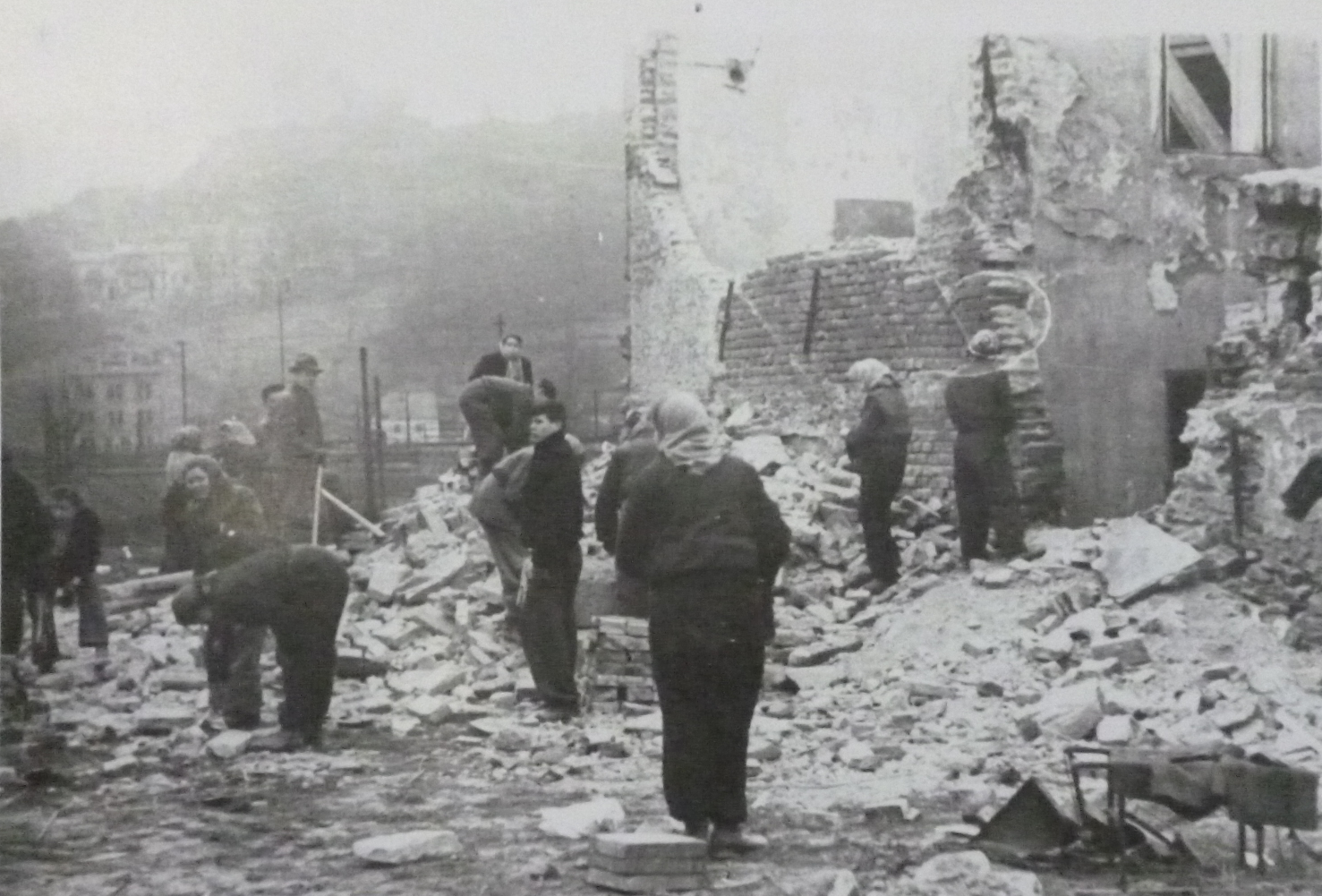
Amateur photo from the volunteer brigade during the reconstruction of Brno in 1954. Source: National Archive CR, fund Ministry of Local Economy.
How did the pandemic impact on the project and how has the project adapted
One major complication caused by the pandemic was the closure of almost all public (film) archives in Europe. The researchers were not able (or only under adverse conditions) to continue their archival explorations. The oral history research was equally affected by the pandemic and interviews with the elderly protagonists had to be moved to almost one year later.
While the pandemic complicated most of our important tasks, it nevertheless gave us the idea and opportunity of virtual teaching, i.e. to offer a joint international online MA seminar “Visual culture of Reconstruction in Post-WWII Europe” for students from our four universities.
Interesting collaborations / partnerships
Associated (archival) partners of the project: DFF – Deutsches Filminstitut und Filmmuseum Frankfurt, the National Film Archive (NFA) in Prague, the Archivio Nazionale Cinema Impresa in Ivrea, and the Association des Cinémathèques Européennes (ACE) as well as EFG- European Film Gateway
Our collaborations with numerous international archives to research films and non-film materials are the most fruitful, such as Cineteca Nazionale (Rome), Archivio Audiovisivo del Movimento Operaio e Democratico (Rome), Historical Archives of the European Union at European University Institute (Fiesole, Florence), Home Movies – National Archive of Family Films (Bologna), Ciné-archives, INA and CNC (Paris), Cinémémoire (Marseille), Médiathèque SNCF (Saint-Denis), National Film Archive in Prague and Slovenský filmový ústav (Bratislava), the Steven Spielberg Jewish Film Archive (Jerusalem),the Landesfilmsammlung Baden Württemberg and the Sächsische Landesbibliothek – Staats- und Universitätsbibliothek, among many other
A large number of the archives mentioned above contributed films to either the thematic collection on EFG – European Film Gateway, one of our associated partners
Historiana (historiana.eu), a transnational platform that offers free historical content, ready to use learning activities, and innovative digital tools made by and for history educators across Europe, were we publish the interactive activities of our educational toolkit
Other institutions and Associations in the fields ofPublic History and Preservation of Cultural Heritage include the Istituto “Antonio Gramsci” in Turin, Associazione “Progetto Memoria” and “Istituto Romano per la storia d’Italia dal fascismo alla Resistenza” in Rome, and the “Magnus-Hirschfeld-Stiftung” (Berlin) and the “Koordinierungsstelle für schulische Gedenkarbeit und Zeitzeugenbegegnungen” in Mainz which collaborated in identifying oral witnesses and gathering their memories. With “Istituto Parri” in Bologna and the “Digital Storytelling Lab” at the University of Udine we collaborated for the toolkit. The Národní muzeum and the “International Documentary Film Festiva”l Ji.hlava, cooperated in workshops and hosted curated film screenings and discussion.
Workshop at the (all-virtual) XXVII FilmForum International Film and Media Studies conference entitled “Eyewitnessing the Past. Questioning Film and Media Agency in Collective Memory and Public History” (November 10th, 2020). The panel featured contributions by the CRP group members and by invited scholars (Andrea Peto, Dagmar Brunow)
Panel at the (all-virtual) NECS conference on “Shifting Borders, Moving Bodies. Non-Fiction Cinema as a Space for Transition(s) in Post-WW II Europe” (June 9th, 2021)
Panel “The Memory of the European World War II Reconstruction Era as Mediated by the Plurimedial Visual Network” at the (all-virtual) Memory Studies Association annual conference, Warsaw (July 8th, 2021)
Panel “Rubbles and Vaults. Making Use of the Non-Fiction Film Heritage for Reassessing Trauma and Reconstruction Culture” at the (all-virtual) “MemWar – Memorie e oblii delle guerre e dei traumi del XX secolo” (December 10th, 2020) https://memwarunige.hypotheses.org/
Presentation “… And from the ruins we arise. Ruins and/as the dawn of a new early in the early post-WWII Czechoslovak and Italian documentaries.” Paris: International symposium “Ruins of the war” (14th – 16th October 2021)
Selected Publications (in English):
Edited volume Non-fiction Cinema in Post-war Europe. Visual Culture and Reconstruction of Public Space, Amsterdam University Press, 2023 forthcoming
Special Issue of Iluminace. The Journal of Film Theory, “History and Aesthetics, Migrating Archives of Reality. Programming, Curating, and Appropriation of Non-Fiction Film”, 1/2022
OA: https://www.iluminace.cz/index.php/en/ (Proceedings of the mid-term conference)
Pitassio and P. Villa, “Mediating Memories. Bridging Gaps Between Non-fiction Film Heritage, Public History, and Media Studies”, in MemWar. Memorie e oblii delle guerre e dei traumi del XX secolo, Genova University Press (forthcoming)
Catanese, “Nastri d’acciaio and Vita di un porto. Industrial Poems of Post-war Reconstruction in the Italian Non-fiction Cinema”, OA journal East of Eden/La valle dell’Eden, n. 38 (forthcoming)
Val, “From moving images to archival films: contemporary uses of non-fiction cinema in the development of rebuilt cities” in MemWar. Memorie e oblii delle guerre e dei traumi del XX secolo, Genova University Press (forthcoming)
Praetorius-Rhein: “Ubiquitous Treasures. Digitization, ephemeral film and local memory”, MemWar. Memorie e oblii delle guerre e dei traumi del XX secolo, Genova University Press (forthcoming)
L. Česálková, “Tanks among Lilacs, Uncertain Icons, and the Audiovisual Memory of the End of the WW II in the Czech Republic,” Memory sStudies (in review)
A. Průchová Hrůzová & M. Kurz, “Moving Cultural Heritage: The Relationship of the Czechoslovak Short Film and Cultural Heritage Policy from 1946 until 1956”, Journal of Contemporary History (work-in-progress)
Haváč,”I recall it as a film sequence. Memory and non-fiction Films.”, Oral History Journal, (work-in-progress)
Interactive work
Thematic collection on EFG- European Film Gateway “Reconstruction in Europe After WWII” https://www.europeanfilmgateway.eu/content/VICTOR-E-project, a searchable and watchable (!) selection of over 650 films (and growing) from numerous European film archives related to our project
Conference page
of our mid-term conference“Migrating Archives of Reality: Programming, Curating, and Appropriation of Non-fiction Film”, https://migrating-archives.com/en, The website contains recording of all the keynotes, papers and round table discussions
Blog
FB page of ViCTOR-E, https://www.facebook.com/VictorE.HERA where we not only post announcements but also blog about our oral history interview tours and other research related events, provide recorded paper presentations and live stream our conferences
Media article
“Sur les routes de France avec Perrine Val, Historienne du Cinema” (in French) https://www.victor-e.eu/media/archive/MP_Sorbonne3_BD_double-seiten-35-37.pdf
French researcher Perrine Val is featured in the last issue of #1257, the in-house research magazine of the Université Paris 1 Panthéon-Sorbonne with a report on her research trip with fellow researcher Ondřej Haváč from Prague for the oral history part of our project:
We use necessary cookies to make our site work. We'd also like to set optional analytics cookies to help us improve it. We won't set these optional cookies unless you enable them. Using this tool will set a cookie on your device to remember your preferences.
For more detailed information about the cookies we use, see our Cookies page
Necessary cookies
Necessary cookies enable core functionality such as security, network management, and accessibility. You may disable these by changing your browser settings, but this may affect how the website functions.
Analytics cookies
We'd like to set Google Analytics cookies to help us to improve our website by collecting and reporting information on how you use it. The cookies collect information in a way that does not directly identify anyone.
 Share on LinkedIn